
Articles > Degradation Rates of Various Plastics in the Ocean Due to the Sun’s Radiation
Date Published: 15 May 2023
Degradation Rates of Various Plastics
in the Ocean Due to the Sun’s Radiation
Joon Ko
Abstract
This science project was designed to study the effects of sunlight on plastics in the ocean. Plastic waste in our oceans is considered by many scientists to be the greatest environmental problem in the world today. Every ocean on the planet now contains one or more huge islands of plastic waste. It is obvious that the rate of plastic waste buildup far exceeds any naturally occurring degradation processes. Perhaps one of the most obvious degradation processes of plastics is ultraviolet radiation from the sun. However, plastics floating in the ocean are protected from the ultraviolet radiation by the ocean water. In this project, six different types of plastics were partially submerged in ocean water and exposed to artificial sunlight. The lamps used in this study replicated sunlight very well. All plastic samples were contained in seawater and were exposed to artificial sunlight continuously for five months. No degradation of any of the plastic samples was observed.
Introduction
The lifestyle of most humans all over the earth is completely dominated by plastics. In the last six to seven decades, the production of plastic materials has been increasing exponentially. Plastics have become the most dominant material in the world because of their high flexibility, lightweight, low cost, excellent storage, and convenience. The oceans of planet Earth have been filling up with plastic waste ever since plastics have become popular in most commercial areas such as food products stored in plastics and medical devices. However, since man-made plastics are not natural materials on the earth, there are no naturally occurring organisms that can break them down effectively. The oceans are where all the plastics that human beings dispose of inappropriately end up, thus plastic pollution in the ocean has become the most significant problem to the ecosystem of the earth.
The plastics flow with the ocean currents and gather at the gyres of oceans, and they create huge garbage patches in the ocean. For example, the greatest garbage patch in the ocean in the Pacific, the Great Pacific Garbage Patch, covers an estimated surface area of 1.6 million square kilometers, an area twice the size of Texas. There are more than five trillion pieces of plastic in the ocean, including both macro and micro pieces of plastic, weighing up to about 300,000 tonnes. Most of the plastics on the earth are being disposed of inappropriately, resulting in the single largest environmental problem facing the earth today.
Marine plastic pollution has killed and damaged hundreds of species in the ocean, including the phytoplankton on the surface of the ocean. Marine plastic pollution is considered a significant problem for human beings because it damages human cells through microplastics in the food and water that people consume. Plastics in the ocean result in the irrational compositions of the earth’s atmosphere because they prevent the growth of phytoplankton in the ocean by blocking the sunlight and consuming the space where phytoplankton should exist. It is estimated that phytoplankton produce about 80% of the world’s oxygen. The plastic degradation rate in the ocean is important because the food chains show that all the degraded microplastics will be consumed by marine organisms such as fish and clams, and finally, humans are going to consume the microplastics.
This laboratory experiment would show the degradation of plastics in the ocean by placing them in the ocean water and shining a sun-imitating lamp on them. The results of this experiment will show the significance of plastic problems on the earth.
The project aims to determine how fast the thrown-away plastics degrade in ocean water. In the experiment, different types of plastic will be filled with ocean water in each tub. Sun-mimicking lamps are used to shine upon the ocean water containing the plastic samples to simulate the conditions the large plastic islands are experiencing.
Through the laboratory experiment, the degradation of plastic in the ocean water will be measured by comparing the initial plastics’ mass to the final plastics’ mass. If the plastic waste degrades, it can be concluded that this degradation process in the ocean will create a serious problem because the plastics would degrade into small pieces which would be consumed by many different species living in the oceans, thus entering the food chain in a very large and significant manner. If on the other hand, it is determined that the degradation process is negligible, the plastic islands will continue to increase in size to the point where oxygen production in our atmosphere will be seriously disturbed.
Experimental Procedure
- Various types of plastic samples were gathered.
- Each plastic sample was classified according to its type of plastic.
- The mass of each plastic sample was measured and recorded.
- Four plastic tubs were prepared that can hold about 5 liters of ocean water.
- The plastic tubs were filled with ocean water, about 4 liters each, and the plastic samples were put into the tubs.
- The plastic tubs were placed under a sun-imitating lamp.

- The ocean water was stirred once a week in order to dissolve the salts that were formed in the tub.
- The tub was filled with tap water as ocean water evaporated to maintain the correct salt concentration.
- After 154 days, each plastic sample was washed with deionized water, dried with paper towels, and allowed to air dry overnight.
- The final mass of the plastic samples was measured and recorded.
- The initial mass of the plastic samples was compared with the final mass of the plastic samples.
- Calculations determined if any plastics showed degradation in the ocean water under the sun.
Data and Data Work-up
Table 1. Plastic Degradation in Tub #1
| Initial Mass (g) (11/17/2022) | Final Mass (g) (4/20/2022) | Change in Mass (g) | Percent Change in Mass (%) | |
| Wellsley Farms Purified Water bottle (PET) | 2.80 | 2.81 | 0.01 | 0.36 |
| Very Strawberry bottle (PETE) | 6.31 | 6.33 | 0.02 | 0.32 |
| Plastic bottle lids (HDPE) | 7.35 | 7.35 | 0.00 | 0.0 |


Figure 1. Initial Mass (g) (11/17/2022) and Final Mass (g) (4/20/2022) in Tub #1

Table #2: Plastic Degradation in Tub #2
| Initial Mass (g)(11/17/2022) | Final Mass (g)(4/20/2022) | Change in Mass (g) | Percent Change in Mass (%) | |
| Styrofoam cup (PS) | 0.92 | 0.95 | 0.03 | 3.3 |
| Red cup (PS) | 3.04 | 3.04 | 0.00 | 0.0 |
| Cushioning foam (PS) | 0.73 | 1.01 | 0.28 | 38 |


Figure 2. Initial Mass (g) (11/17/2022) and Final Mass (g) (4/20/2022) in Tub #2

Table #3: Plastic Degradation in Tub #3
| Initial Mass (g)(11/17/2022) | Final Mass (g)(4/20/2022) | Change in Mass (g) | Percent Change in Mass (%) | |
| Gatorade label (PET) | 0.37 | 0.36 | -0.01 | -2.7 |
| Twix wrapper (PP) | 0.86 | 0.85 | -0.01 | -1.2 |
| Cheez-It wrapper(PET) | 0.43 | 0.42 | -0.01 | -2.3 |


Figure 3. Initial Mass (g) (11/17/2022) and Final Mass (g) (4/20/2022) in Tub #3

Table #4: Plastic Degradation in Tub #4
| Initial Mass (g)(11/17/2022) | Final Mass (g)(4/20/2022) | Change in Mass (g) | Percent Change in Mass (%) | |
| Tub wrapper (PET) | 1.14 | 1.15 | 0.01 | 0.88 |
| Bubble wrapper (LDPE) | 0.97 | 1.03 | 0.06 | 6.2 |


Figure 4. Initial Mass (g) (11/17/2022) and Final Mass (g) (4/20/2022) in Tub #4

Table #5: Power Emissions from Different Sun-Imitating Lamps
| Lamps | Power Emissions (mW / cm2) |
| Lamp #1 | 0.68 |
| Lamp #2 | 0.90 |
| Lamp #3 | 0.58 |
| Lamp #4 | 3.12 |
Results & Discussion
According to the data collected, no measurable plastic degradation was observed after 154 days of the exposure. Wellsley Farms Purified Water bottle (PET) showed 0.01 g, or 0.36% gain in mass. Very Strawberry bottle (PETE) showed 0.02 g, or 0.32% gain in mass. Plastic bottle lids (HDPE) showed no change in mass. Styrofoam cup (PS) showed 0.03 g, or 3.3% gain in mass. Red cup (PS) showed no change in mass. Cushioning foam (PS) showed 0.28 g, or 38% gain in mass. Gatorade label (PET) showed 0.01 g or 2.7% loss in mass. Twix wrapper (PP) showed 0.01 g, or -1.2% loss in mass. Cheez-It wrapper (PET) showed 0.01 g or 2.3% loss in mass. Tub wrapper (PET) showed 0.01 g, or 0.88% gain in mass. Bubble wrapper (LDPE) showed 0.06 g, or 6.2% gain in mass.
The lamps were examined using a spectroscope which showed a continuous spectrum in the entire visible region and also showed uv emission. Following the spectroscope analysis, a monochromatic intensity meter registered the power the lamps were emitting at a wavelength of 365 nm, a UV wavelength. At this wavelength, the lamps’ power emission ranged from 0.58 mW per cm2 to 3.12 mW / cm2.
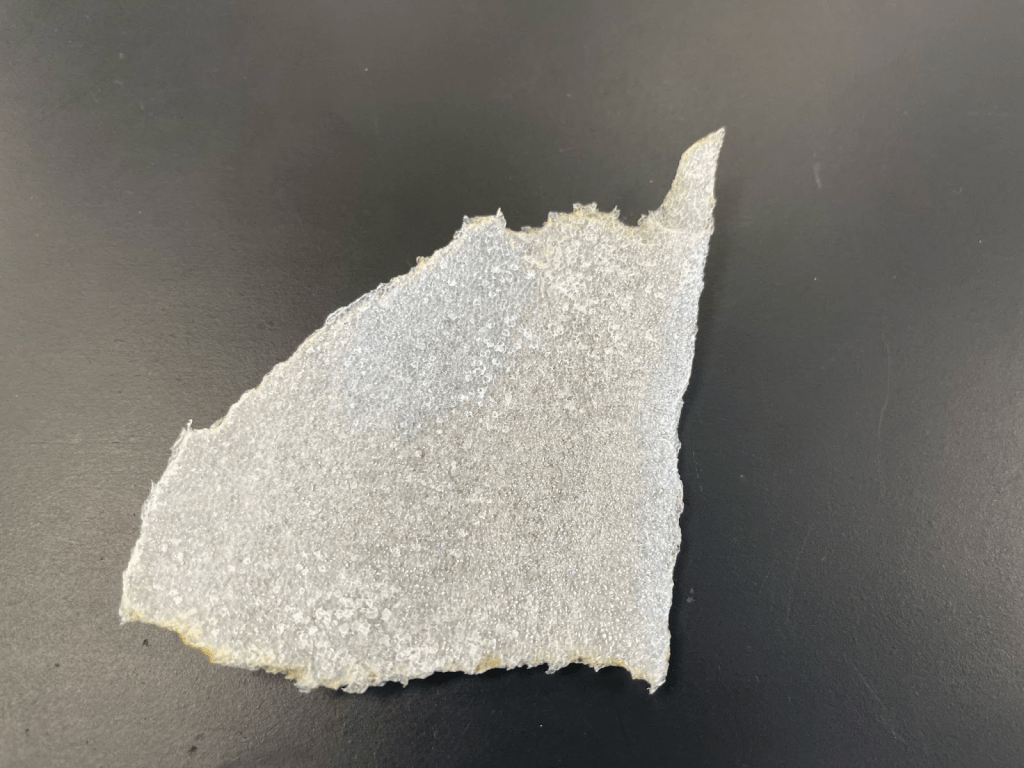
Cushioning foam (PS), bubble wrapper (LDPE), and styrofoam cup (PS) showed significant gain of the mass of the plastic samples. The foam samples have high porosity in which the ocean water entered. The bubble wrap had bubbles that leaked, allowing ocean water to enter the bubbles. Upon drying these samples, considerable salts remained in the porosity of the foam samples and in the bubbles in the bubble wraps. The gain in mass in these samples is due to the salts remaining in these samples.
Conclusion
Our results show that plastics in the ocean water do not degrade under the sun’s radiation. It is well-known that UV radiation degrades plastics at an appreciable rate. It is assumed that the ocean water stops the UV radiation from hitting the plastics. It is a very serious problem because if the plastics in the ocean do not degrade, the plastic islands will continue to grow. The plastic islands block the sun’s energy, preventing phytoplankton growth. Phytoplankton supplies about 80% of our atmosphere’s oxygen. The continuous growth of the plastic islands in our oceans will undoubtedly have a negative effect on the production of atmospheric oxygen. This is a very serious problem which does not seem to be being addressed by the scientific community and more importantly, our political leaders worldwide.
.
Works Cited
Abbott, Ron. “Microplastics@Whoi.” Microplasticswhoi, Chevron Phillips Chemical Company,
https://microplastics.whoi.edu/events-presentations/the-science-of-microplastics-in-the-world-ocean/abstracts/#:~:text=Abstract%3A%20It%20is%20estimated%20that,1%20%C2%B5m%20and%205%20mm.
US Department of Commerce, National Oceanic and Atmospheric Administration. “A Guide to Plastic in the Ocean.” NOAA’s National Ocean Service, National Oceanic and Atmospheric Administration U.S. Department of Commerce, 20 Sept. 2018,
https://oceanservice.noaa.gov/hazards/marinedebris/plastics-in-the-ocean.html#:~:text=Unlike%20some%20 other%20kinds%20of,into%20tiny%20 pieces%2C%20called%20 microplastics.
California, S. of. (n.d.). Plastic Pollution. Plastic pollution – California Ocean Protection Council. Retrieved May 17, 2022, from
https://www.opc.ca.gov/programs-summary/marine-pollution/plastics/
Avakian, M. (n.d.). New study finds ocean pollution a threat to human health. National Institute of Environmental Health Sciences. Retrieved May 17, 2022, from
https://www.niehs.nih.gov/research/programs/geh/geh_newsletter/2021/2/articles/new_study_finds_ocean_pollution_a_threat_to_human_health.cfm
Editor-in-Chief: Joon Ko
jko1@gvcspa.org
Global Vision Christian School Broadfording
13535 Broadfording Church Rd, Hagerstown
Website Manager: Gyeongwoo Yuk
gyuk1@gvcspa.org
 BroadfordingScience